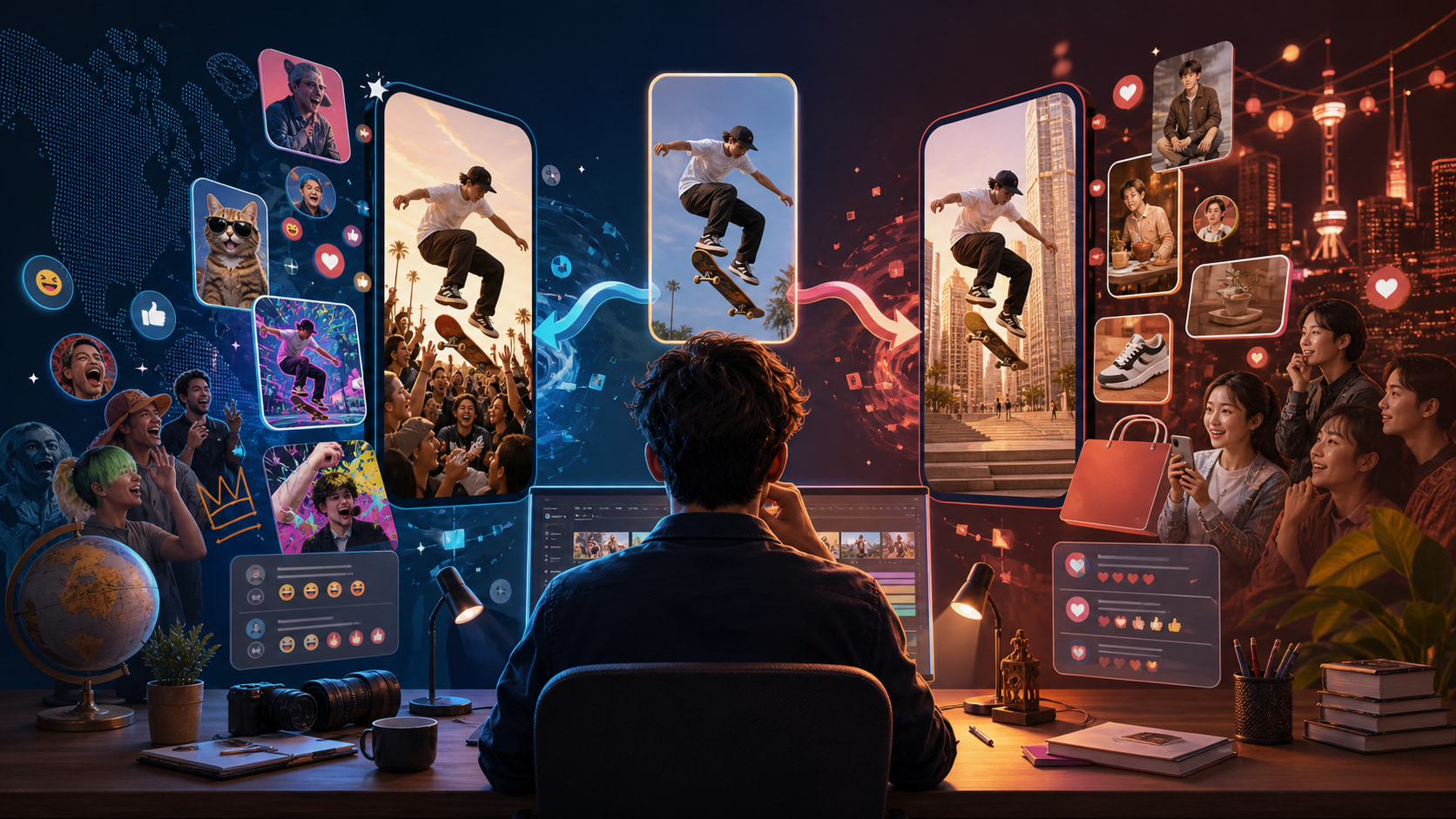

Imagine discovering that you already have an audience in China—only the audience belongs to someone else.
A creator searches their name, signature video, or niche on a Chinese platform. There it is: their footage, retitled in Mandarin, perhaps subtitled, recut, or placed inside a compilation. The upload has comments the creator never read, followers they never met, and possibly a commercial path they never controlled.
That discovery changes the usual question. It is no longer, “Would Chinese viewers care about my content?”
Someone has already bet that they will.
The blue ocean is not empty. It is underserved by the original creators.
Foreign perspective is the product
Chinese audiences do not need international creators to imitate local creators perfectly. The difference is often the attraction.
A foreign chef can show an ordinary family meal that feels new in China. A filmmaker can reveal how another country works behind the postcard. A science creator can bring a teaching style viewers have not seen locally. Fitness, design, wildlife, engineering, music, comedy, parenting, travel, and everyday work can all become windows into another life.
Research on foreign influencers in China describes them as cultural brokers: audiences use their content both to understand other countries and to see China through an outsider's eyes. Another study of 33 foreign creators on Douyin found that successful creators did more than appear foreign; they used cross-cultural communication, deliberate self-presentation, Mandarin, editing, and platform-native storytelling.
That is the opportunity. Your background may supply the initial curiosity. Your ability to make that curiosity useful, entertaining, and trustworthy creates influence.
The January 2025 migration of American users to Xiaohongshu offered a rare public demonstration. The Associated Press reported Chinese users meeting English-language posts with curiosity, jokes, practical exchanges, and conversations about pets, family life, prices, and culture. The moment was unusual, but the desire for direct human contact was easy to see.
Repost accounts reveal the demand
The clearest market signal is sometimes not a research report. It is the infrastructure that already exists to move foreign content into China.
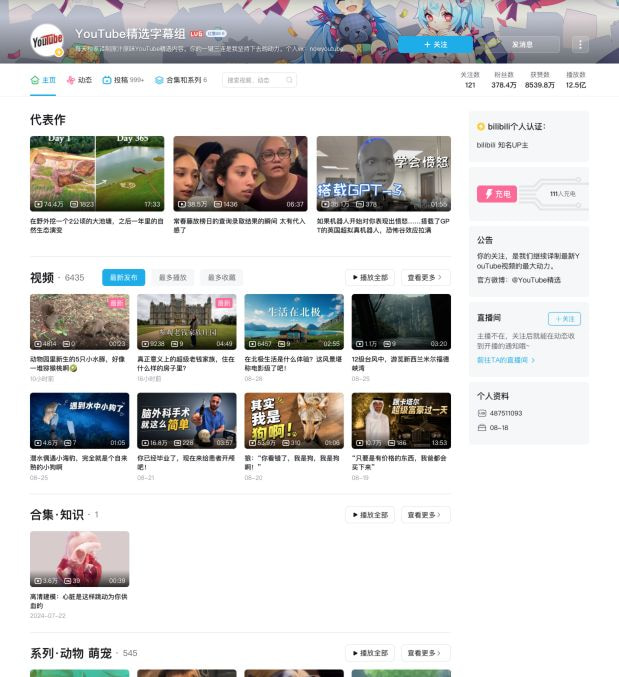
On September 2, 2026, we inspected two public Bilibili profiles in the browser. The first, YouTube精选字幕组—roughly “YouTube Selected Subtitles Group”—described itself as translating selected YouTube content. Its visible profile showed approximately 3.78 million followers, 6,435 videos, and 1.25 billion cumulative plays.
The second, FUNNY-ANIMALS, displayed approximately 1.64 million followers, 6,236 videos, 111 million likes, and 1.43 billion cumulative plays. The page also visibly marked the account as banned. Bilibili did not state the reason for that status on the public profile.
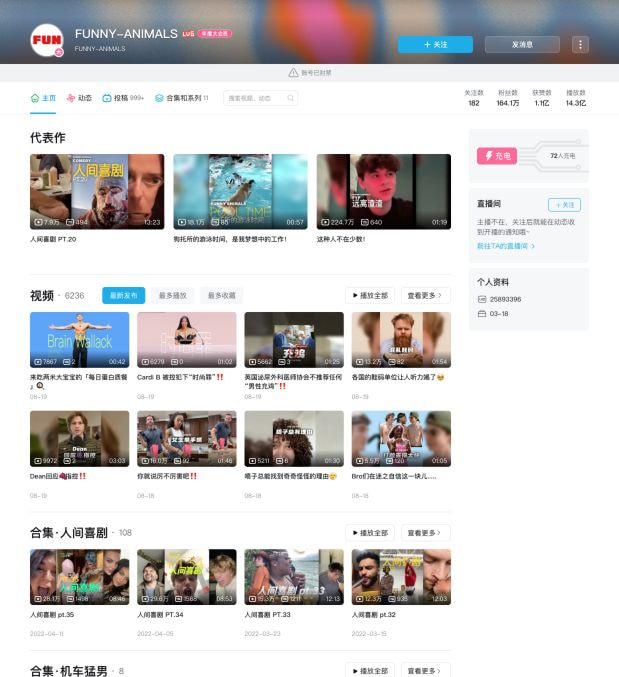
These screenshots prove what was visible on those pages at that moment. They do not establish the licensing status of every upload, the source of every clip, why FUNNY-ANIMALS was banned, or how much either account earned. Translation and compilation channels can operate with permission, without permission, or with a mixture of rights arrangements that are invisible to viewers.
What they do demonstrate is audience appetite at extraordinary scale. Foreign stories are already being selected, packaged, translated, and distributed for Chinese viewers.
Attention can travel without its creator
When a third party builds the Chinese audience first, the original creator may lose more than views.
They lose the account relationship. They cannot see complete analytics, answer the community in their own voice, guide viewers toward an official profile, choose which brand partnerships fit, or use audience questions to shape the next episode. Attribution may disappear. Context may change. A careless translation can make the creator sound like someone they are not.
There may also be foregone revenue, but it should not be exaggerated. A repost's views do not prove that the original creator would have received the same distribution or qualified for the same monetization. Programs depend on platform, region, account status, content rights, and current rules.
Still, the commercial ecosystem is real. Bilibili reported that millions of creators earned income through its monetization channels in 2024, while Weibo's creator tools include data, revenue, campaigns, and monetization features. The opportunity is not a guaranteed payout. It is the ability to build an owned asset instead of donating the market test to an intermediary.
Reposting is not automatically permission
China's copyright framework does not create a general “it was already online” exception. The National Copyright Administration has said internet media generally need permission, payment, and attribution when republishing protected works, subject to legal exceptions. Bilibili provides an infringement-complaint process for intellectual-property owners, and Weibo's terms prohibit malicious copying and infringement.
This is not legal advice, and enforcement can be difficult across borders. Creators should preserve original files and publication dates, document suspicious uploads, use platform reporting channels, and seek qualified counsel when the value or risk justifies it.
But takedowns alone do not create a Chinese audience. Protection works better when paired with presence: an official account gives viewers somewhere legitimate to go.
Start with a small owned beachhead
International creators do not need to translate an entire archive or launch on every Chinese platform at once. A focused pilot is enough to test whether the blue ocean fits.
Choose one platform based on format and audience. Select three to five ideas with strong universal appeal and a distinctive international point of view. Then localize the premise, hook, Mandarin language, cover, pacing, cultural references, category, and call to action. Publish from an account the creator controls, and stay present in the comments.
At the same time, search for existing copies of the creator's name, signature series, and most viral clips. The goal is not to begin a war with every fan translator. Some communities may become licensed partners, collaborators, or useful discovery channels. The goal is to understand who is representing the work and establish a clear official home.
Measure returning viewers, follows per view, saves, profile visits, meaningful comments, and repeatable audience questions—not just the largest play count. Influence begins when viewers recognize who is speaking and choose to come back.
The easiest audience to lose is one you never claimed
Chinese social media is a blue ocean for many international creators because the supply of direct, authentic foreign voices remains uneven while visible demand already exists. That can make early traction easier than entering an exhausted content category at home—but never automatic. Localization, compliance, rights, consistency, and community work still decide whether curiosity becomes durable influence.
The repost account is both competitor and proof of concept. It shows that your content can cross the border. Your job is to make sure the identity, relationship, learning, and value cross with it.
If you want to test where your content fits, explore our China platform overviews or talk with SAIKO Network about an owned, localized launch.
Sources and further reading
- SAGE Open: Foreign influencers on Chinese digital platforms
- East Asia: How foreigners achieve internet celebrity in China
- Associated Press: Direct cultural exchange on Xiaohongshu
- Bilibili: YouTube精选字幕组 public profile
- Bilibili: FUNNY-ANIMALS public profile
- Bilibili: Infringement complaint process
- National Copyright Administration of China: Rules on online republication
- Weibo service agreement and intellectual-property rules